
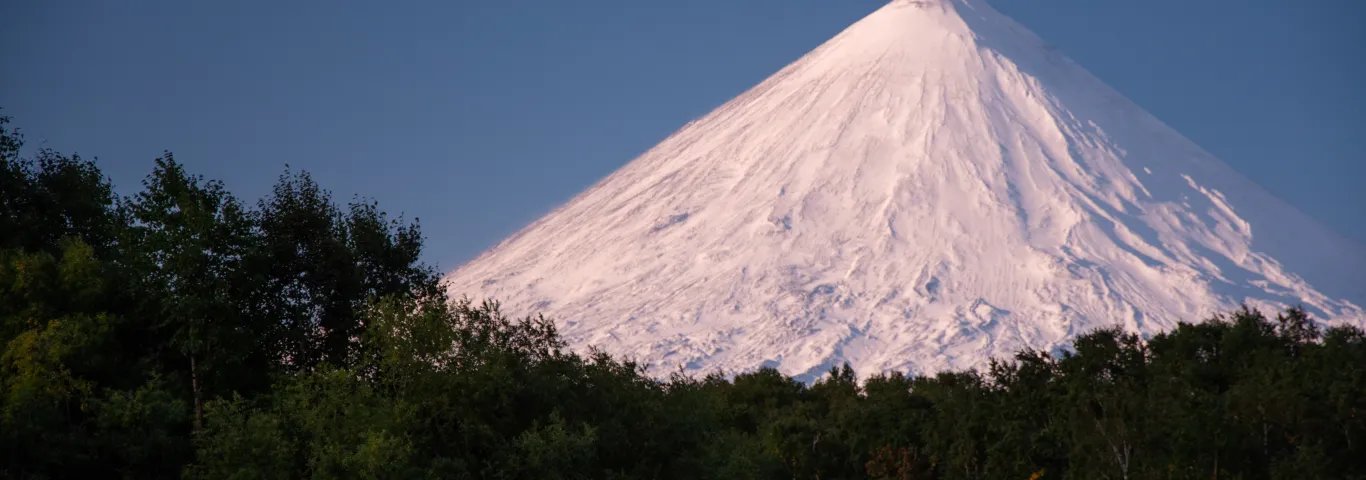
The large earthquake that hit Russia’s Kamchatka Peninsula last week was measured as a total magnitude of 8.8. This reading ties the earthquake for sixth-strongest ever recorded by seismometers and the biggest in the world since 2011. Shockwaves felt through the region made way for volcanic eruptions in the area. Klyuchevskoy volcano, one of the most active volcanoes in this region with at least four explosions recorded in the 2020s, began new activity around the same time as the earthquake.
Associate Professor Mike Krawczynski studies the intense volcanic activity in the Kamchatka Peninsula, and published a study on August 01, 2025 in Contributions to Mineralogy and Petrology which used a large dataset of olivine-hosted melt inclusions (MIs) from Klyuchevskoy volcano. Many of these samples were recovered during fieldwork conducted in 2017 at Klyuchevskoy volcano.
In this study, Krawczynski and fellow researchers examined the use of geohygrometry, measuring water content in magmas and rocks, in order to enhance the accuracy and applicability of the technique in studying magmatic processes. The melt inclusions from Klyuchevskoy, one of the most productive arc volcanoes globally, were chosen as they have a wide compositional range of host olivines and researchers believe they represent magmas at different stages of magma evolution. Studying the water content dissolved in magmas is important for many reasons including that the dissolved water content can lead to explosive and hazardous volcanic activity.
Kamchatka is an incredibly dynamic area geologically, and although remote, the intense activity there causes tsunamis such as the waves that even reached the shores of Hawaii and North America last week. In addition to the earthquake, volcanic activity triggered aviation hazard warnings.

“Our study focused on revealing details of the Klyuchevskoy plumbing system, which traces the magma pathway all the way from the mantle to the surface of the Earth.” In the study, the research revealed that Klyuchevskoy has an extremely rapid ascent of magma from the mantle to the surface. The research highlights the deep nature of the plumbing system, which would seem unlikely a shallow earthquake would trigger an eruption. “Despite the coincidental timing of the large earthquake and the volcanic eruption, it is hard to conclusively say that the eruption was directly triggered by the shaking. However, it is a good reminder that active volcanoes do often sit at the edge of eruption, and it can’t be ruled out that the shaking did initiate some activity that was already brewing.”
Other volcanic activity triggered by the massive earthquake was at the Krasheninnikov volcano, which has been dormant for nearly 600 years and lies roughly 130 km (80 miles) away from Klyuchevskoy. This earthquake and the volcanic activity that followed was an exciting and historic event for seismologists and volcanologists alike.
Header Image Credit: Michael Krawczynski, 2017

Krawczynski and fellow researchers conducting field work on Klyuchevskoy in 2017. Credit: Mike Krawczynski
