
Dougal Hansen is pioneering groundbreaking research in glaciology, unlocking the secrets of glacier dynamics and their impact on our planet.

Dougal Hansen is an emerging talent at Washington University in St. Louis, where he serves as an Assistant Professor in both Earth, Environmental, and Planetary Sciences, and Environmental Studies. Since joining the university last summer, Hansen, who is also a fellow in the McDonnell Center for the Space Sciences, has introduced innovative research approaches and a fresh perspective to glaciology.
Hansen’s expertise lies in the "nuts and bolts mechanics" of glacier motion, focusing on how glaciers move and transform over time. His research delves into the experimental aspects of glaciology, particularly examining how ice slides, especially at its melting point. This work is crucial for understanding fundamental processes that impact global sea levels, erosion, and glacial hydrology. Supported by grants from the Arête Glacier Initiative, his research aims to mitigate the risks of catastrophic sea-level rise.
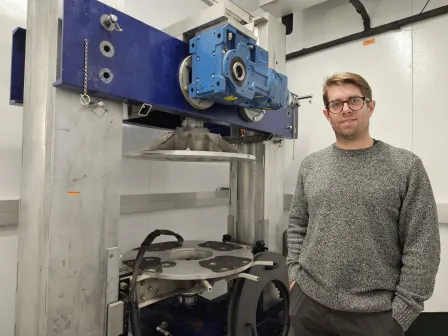
In the basement of Rudolph Hall at WashU, Hansen is constructing a state-of-the-art cold lab, set for completion this spring. This lab will be a cornerstone for his experimental research, equipped with two cryogenic ring shear devices, and a unique pressurized subglacial flume. One of the cryogenic ring shear devices was originally built for Iowa State University (ISU) and recently relocated to WashU, while the other is under construction. The cryogenic ring shear devices will enable Hansen and his team to simulate shear stress and strain that ice undergoes as it moves, providing insights into its mechanical properties and behavior under various pressure and temperature conditions. This instrument is critical for understanding how glaciers deform and flow, particularly at their melting point.
The pressurized subglacial flume, being designed specifically for WashU, will allow the team to replicate the hydrological processes occurring beneath glaciers. By controlling water pressure and flow within the flume, researchers can study the interactions between water and ice, such as how water lubricates the glacier bed, influences ice sliding, and contributes to ice melt. These simulations are vital for understanding subglacial water flow, which plays a significant role in glacier dynamics and stability.
Together, these tools will enable Hansen's team to simulate real-world glacial conditions and study them in unprecedented detail, advancing our knowledge of glaciology and the factors affecting global sea levels and climate change.
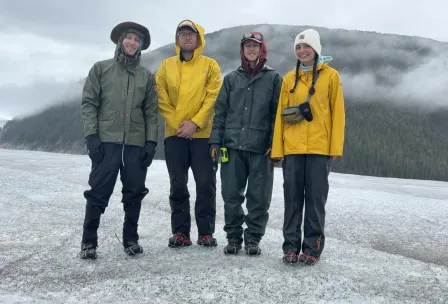
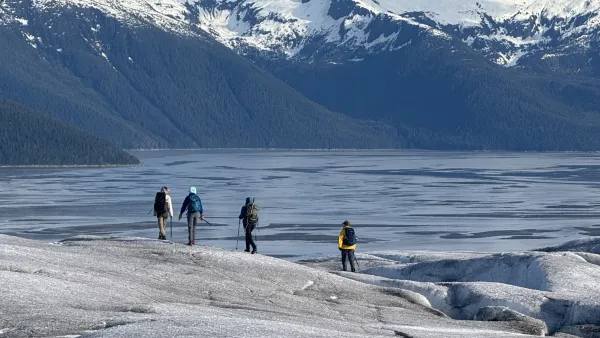
In addition to his lab-based research, Hansen’s fieldwork is equally impressive. He has spent considerable time conducting field research in Alaska's rugged landscape. Hansen is currently involved in a multi-year geophysical campaign at Taku Glacier on the Juneau Icefield in southeast Alaska, in collaboration with the Juneau Icefield Research Program and researchers at the University of Alaska Southeast, Cornell University, and the University of Wisconsin–Madison. The goal of this study is to investigate how basal conditions and hydrology influence the glacier’s unique seasonal dynamics. In June 2025, Hansen and his team carried out active and passive seismic experiments in the ablation zone, deploying 88 seismic nodes. They will return in summer 2026 to redeploy these instruments, this time supplemented with instrumented boreholes, stream hydrologic sensors, and ice-penetrating radar. Joining him on this expedition will be Roger Michaelides, an Assistant Professor of Earth, Environmental, and Planetary Sciences, and also a fellow in the McDonnell Center for the Space Sciences. These field studies aim to provide valuable data on how water movements beneath glaciers can influence their speed and stability.
Hansen's ambitions extend beyond Earth’s ice. Utilizing a custom ice permeameter, recently relocated to WashU from ISU, he and a collaborator at the University of Pennsylvania aim to unlock the secrets of the briny ice on Europa, one of Jupiter's moons, with the goal of better understanding the role of fluid migration within its ice shell. This extraterrestrial study could offer fascinating comparisons to terrestrial glaciers and expand our understanding of icy bodies in the Solar System.
Dougal Hansen’s academic journey began with a B.S. in Geology and Mathematics from Portland State University, followed by a PhD in Geoscience from the University of Wisconsin-Madison. He further honed his expertise in glaciology as a postdoctoral researcher.
Outside the lab, Hansen enjoys the vibrant life of St. Louis. He appreciates the city’s comfortable lifestyle, often biking in Forest Park and exploring the diverse local cuisine. The blend of nature and urban life in St. Louis provides a perfect backdrop for both relaxation and inspiration.
Dougal Hansen’s contributions to glaciology blend rigorous science with practical fieldwork and innovative experimentation. His research not only expands scientific knowledge but also plays a critical role in understanding and mitigating the impacts of climate change.
Header image: Hansen and his field team traversing the Taku Glacier.


