
Hosted by the Department of Physics and led by the department’s Outreach Team, the annual event invites curious minds of all ages to explore hands-on demonstrations, ask questions, and experience the wonder of science in action.
Graduate students from Physics and Earth, Environmental, and Planetary Sciences (EEPS) designed and ran a full lineup of interactive stations, each highlighting a different way light behaves and how scientists use those behaviors to understand the world around us.

Measuring the speed of light, with chocolate
One of the most popular demonstrations showed families how to estimate the speed of light using nothing more than a microwave and a chocolate bar. By removing the microwave’s rotating plate and heating the chocolate just long enough to create distinct melt spots, kids could measure the distance between the melted areas to determine the microwave’s wavelength. When paired with the microwave’s listed frequency, families calculated the speed of light using c = frequency x 2 x distance between melt spots. All participants recorded their results in a shared spreadsheet, turning the demo into a lesson about repeated measurements and the power of scientific collaboration.

Prisms, refraction, and disappearing glass
Another station used prisms to break white light into its full rainbow spectrum. Volunteers also demonstrated how materials with the same index of refraction – like glycerol and glass – bend light in the same way. By submerging a glass stirring rod in glycerol, the rod appeared to “vanish,” delighting kids and sparking conversations about why our eyes perceive objects the way we do.
Spectroscopy with gas tubes
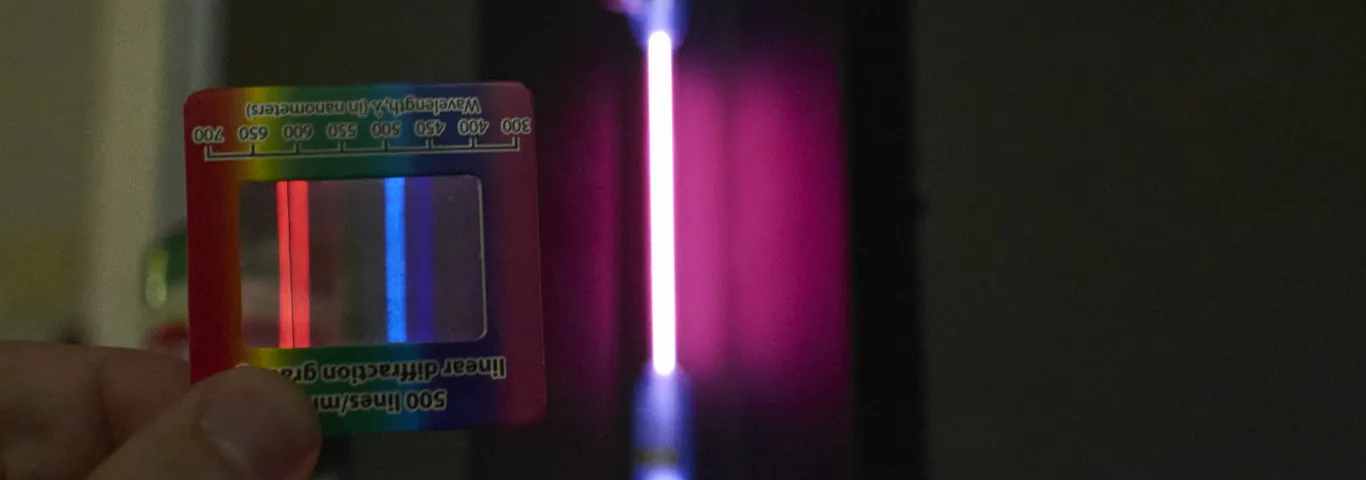
Building on the prism demonstration, the gas tube station showed how different elements emit distinct wavelengths of light when excited. Visitors looked through diffraction gratings (acting like 2D prisms) to see bright emission lines – an introduction to the same techniques astronomers use to determine the composition of distant stars.
A hands-on laser maze
Crowd favorites also included the laser maze, where participants used small mirrors to guide a laser beam around obstacles toward a target. Kids quickly picked up the principles of reflection as they experimented with angles, mirror placement, and creative problem-solving.

Fluorescing rocks – and olive oil that glows
EEPS graduate students transformed the museum area of Rudolph Hall into a glowing display of fluorescent minerals, explaining why certain rocks light up under UV lamps. Nearby, another demo showed how a green laser “changes color” when it passes through olive oil – an effect caused by chlorophyll in the oil absorbing the green light, exciting the electrons to a higher level. When the electrons return to their ground state, they release lower-energy photons of light, appearing orange or red to the human eye.
A community event that keeps growing
Audrey Coleman, lead of the Outreach Team and Physics Graduate student, reflected on the impact of the day, saying, “We had over 100 people in attendance this year! It’s always rewarding being able to teach people how the world works, especially those unaffiliated with the University. We had a lot of fun and we look forward to our next Physics Family Fun Day.”
From glowing minerals to rainbow prisms and microwaved chocolate, this year’s Physics Family Fun Day offered something for everyone – inviting families from across St. Louis to discover how light behaves and why physics helps us understand the world in brighter, clearer ways.

All photos provided by Dr. Wolfgang Zober
