

This summer, the Department of Earth, Environmental, and Planetary Sciences welcomed its newest assistant professor, Dougal Hansen. He joins Washington University after eight years of collaboration with Lucas Zoet, Associate Professor and Dean L. Morgridge Chair in Geoscience at the University of Wisconsin–Madison. Hansen is a glaciologist specializing in the study of the cryosphere, the frozen regions of Earth, including glaciers, ice sheets, permafrost, and their interactions with broader Earth systems.
The experimental glaciology lab in Rudolph Hall is currently under construction and is scheduled for completion within the academic year. It will include two large cold rooms, each equipped with a custom, large-diameter cryogenic ring shear device designed to replicate the processes governing glacier and ice sheet flow. One of these instruments is being acquired from Iowa State University—the first of only two such devices worldwide—while the second is a newly designed, purpose-built system for Washington University.

Seismometer installed in ice during field work. Credit: Dougal Hansen
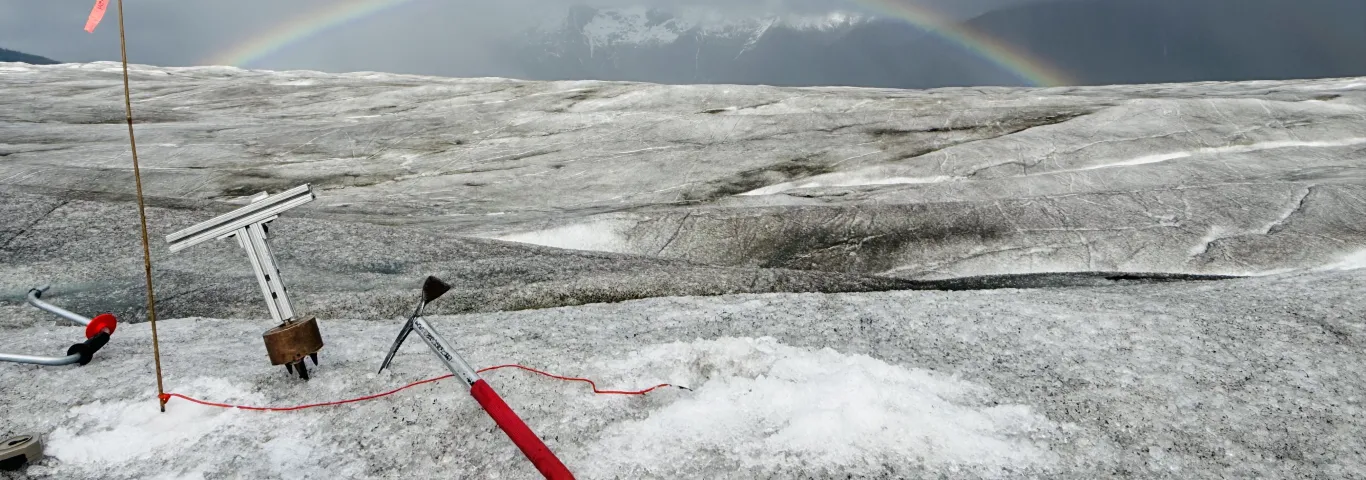
Anywhere you find glaciers is a great place for glaciology work. Just before the fall semester, Dougal led a team on the Juneau Icefield in southeast Alaska to conduct geophysical fieldwork focused on glacier sliding. Findings from this campaign will help improve models and provide insights into larger glacier systems such as those in Greenland and Antarctica. Over the summer, the team deployed approximately 90 seismometers to record icequakes and subglacial water flow. The instruments have now been returned to WashU, where the collected data will be analyzed.
The Department of Earth, Environmental, and Planetary Sciences fosters a diverse range of research that encourages cross-collaboration. Current strengths include Doug Wiens’s seismology lab; Roger Michaelides’s radar interferometry and geospatial science laboratory, which advances permafrost studies through radar remote sensing; and Claire Masteller’s geomorphology lab, which examines sediment transport and near-surface geophysics. The Experimental Studies of Planetary Materials group—comprising Phil Skemer’s rock deformation lab and Mike Krawczynski’s experimental geochemistry lab—investigates the mechanical and chemical behavior of rocks. Building on this foundation, Hansen is eager to grow the cryosphere research group and develop new partnerships within the department and beyond.
Header image: Tools used to install seismometers on icefield, Juneau Icefield. Credit: Dougal Hansen


