
EEPS Colloquium: Mark Jellinek
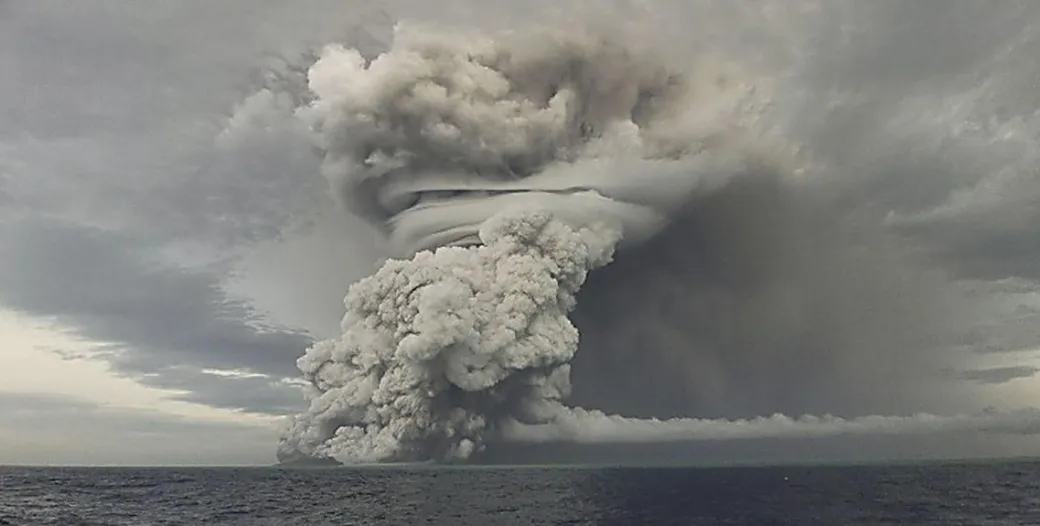
The immense January, 2022 eruption of Hunga-Tonga Ha’apai volcano (HTHH) captured the imaginations of millions of people. The rise of the eruption column of ash and entrained gases through a shallow ocean to unprecedented altitudes in the stratosphere caused the collapse of an island into the sea to form a caldera. In popular news media, the simultaneous and visually arresting spread of a cloud of mostly water vapor at ~58 km and a cloud of mostly layered ash at ~35 km altitude raised the specter of a global climate catastrophe arising from a potential much larger “catastrophic caldera-forming” (CCF) eruption at Yellowstone. To climate scientists whose state-of-the-art global climate models are tuned to predict well-characterized surface cooling effects of “stratovolcanic” events such as the comparably powerful 1991 eruption of Mt. Pinatubo (PT), however, a virtual absence of climate impacts from HTHH clouds was troubling and astonishing. Such a powerful event at low latitude “should” have triggered stratospheric warming and Northern hemisphere surface cooling related to the delivery of ash, SO2, H2O and halogens into and across the stratosphere. Indeed, the efficient oxidation of SO2 to produce highly-reflective sulfur aerosol particles usually drives a strong, transient “volcanic radiative forcing” (VRF) through effects of a net warming in the stratosphere on Earth’s radiation balance. The VRF and surface cooling related to stratovolcanic eruptions typically increases with eruption column height and with the injection rate of mass delivered across the tropopause, so where was the HTHH cooling? Furthermore, why was so little of the erupted SO2 ultimately injected into the stratosphere and so much H2O delivered so high? Do we really know that the climate effects of a massive Yellowstone eruption will be significant? Can we reliably predict the extent to which typical stratovolcanic volcanism will modulate anthropogenic global warming or climate variability in coming decades or centuries?
The magnitude, longevity and global scale of explosive volcanic effects on climate change comes down ultimately to one question: What erupted material goes where? When compared, the “mass partitioning” properties of eruptions on land and under water are distinct and a key to progress is building understanding of why. In this talk I will use a mix of laboratory experiments, theoretical models, field and atmospheric observations to build a picture of how processes acting at scales ranging from 50 µm ash and ice particles to the kilometer-scale overturning motions that can govern atmospheric and water entrainment act together to determine how and where erupted material is injected across the atmosphere. Time-permitting, I will also discuss how we use knowledge gained from stories told by observers of a historical eruption on Iceland to constrain our models and to understand what we have learned and what is still missing.
