
How do you prove a black hole exists? During her March visit to WashU, the 2020 Nobel Prize in Physics recipient will explain how decades of precise measurements turned the idea of a supermassive black hole at the center of our galaxy into scientific certainty.
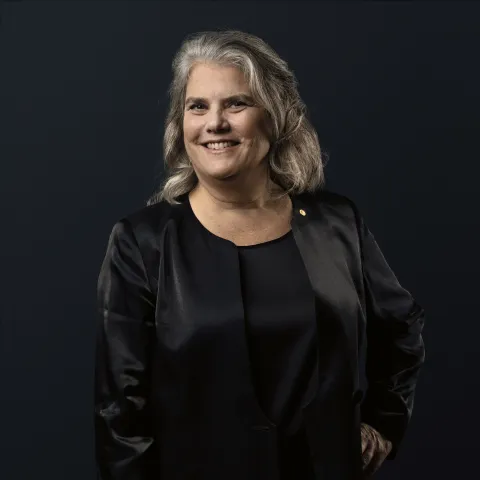
Few scientists have answered that question more definitively than Andrea Ghez.
Ghez is a professor of physics and astronomy at the University of California, Los Angeles, and holds the Lauren B. Leichtman & Arthur E. Levine Chair in Astrophysics. A world leader in observational astrophysics, she directs UCLA’s Galactic Center Group and has devoted more than 30 years to studying the dynamic environment surrounding Sagittarius A*, the supermassive black hole at the heart of the Milky Way. Her work recast a long-standing astronomical mystery into a vivid demonstration of gravity in action.
Later this month, the McDonnell Center for the Space Sciences (MCSS) at WashU will welcome Ghez as the featured speaker for the 2026 McDonnell Distinguished Lectures, offering the university community and the public a rare opportunity to hear directly from one of the scientists who proved that supermassive black holes are not theoretical curiosities, but measurable physical realities.
Black holes themselves emit no light. So how do you prove it?
Her answer was simple. She watched the stars.
By tracking the rapid, intricate orbits of stars near Sagittarius A*, the compact radio source at our galaxy’s center, Ghez and her team measured their motions with unprecedented precision. What they found was unmistakable. These stars race around an unseen object with a mass about four million times that of our sun, compressed within a region smaller than our solar system. No known alternative explanation could account for such an immense gravitational pull.
In 2020, Ghez became only the fourth woman ever to receive the Nobel Prize in Physics. One half of the prize was awarded to Roger Penrose for demonstrating that black hole formation is a robust prediction of Einstein’s general theory of relativity. Ghez and Reinhard Genzel were awarded the other half for their independent discovery of a supermassive compact object at the center of the Milky Way. The Nobel committee cited her work as providing the strongest evidence to date that a supermassive black hole resides at the center of our galaxy.
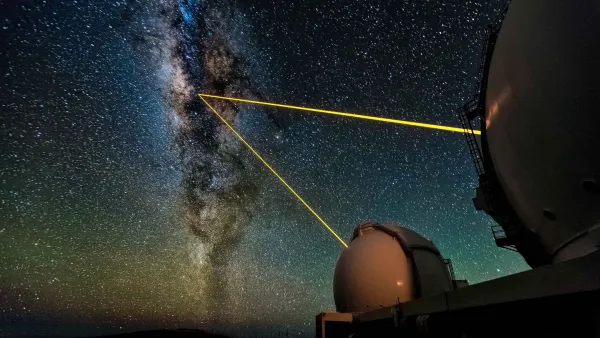
Those measurements required not only patience, but technological innovation. Earth’s atmosphere blurs astronomical images, an effect Ghez compares to “looking at a pebble at the bottom of a rippling stream.” To overcome this distortion, her team developed and refined increasingly sophisticated high-resolution imaging techniques, including adaptive optics, using the twin 10-meter telescopes at the W. M. Keck Observatory in Hawaii.
With adaptive optics correcting atmospheric turbulence in real time, Ghez’s group achieved diffraction-limited images from the ground, a milestone once considered out of reach for ground-based astronomy. Over three decades, those crisp images captured full stellar orbits and resolved a decades-old hypothesis into definitive evidence.
The implications of that discovery reach far beyond our galaxy’s center.
By tracing stars through extreme gravitational fields, Ghez’s work has opened a new testing ground for Einstein’s theory of general relativity. The Galactic Center is now one of the best laboratories for probing gravity under conditions that had never before been measured directly, allowing astronomers to test relativity in ways impossible to reproduce on Earth.
At the same time, her observations have revealed surprising features, including young stars where none were expected, missing older stars, and puzzling new populations that challenge existing models of galactic evolution. What began as a search for a black hole has become a deeper investigation into how galaxies grow, and into the role black holes play in shaping the cosmos around them.
As William McKinnon, director of the McDonnell Center for the Space Sciences, notes, “It has become increasingly clear that rather than being some exotic, peripheral phenomenon, black holes may be key to understanding the origin and ultimate fate of our Universe. Prof. Ghez's lectures promise to be amazing!”
Ghez’s path to astrophysics began early. Inspired by the Apollo moon landings, she once imagined becoming an astronaut. That early fascination with space evolved into a career focused not on traveling beyond Earth, but on pushing the limits of what could be seen from it. She earned her B.S. in physics from MIT and her PhD from Caltech. After joining the UCLA faculty, she assembled and led a global collaboration devoted to studying the Milky Way’s core. That collaboration redefined what astronomers could measure in the extreme environment surrounding a black hole.
Her scientific achievements have been widely recognized. In addition to the Nobel Prize, she received the Crafoord Prize in Astronomy from the Royal Swedish Academy of Sciences, becoming the first woman to receive the award in any field, and has been elected to the National Academy of Sciences, the American Academy of Arts & Sciences, and the American Philosophical Society. Together, these honors underscore the global significance of her contributions to astrophysics.
Yet Ghez often emphasizes that recognition carries a responsibility to expand opportunity for others. She has frequently spoken about the importance of visible role models in science and about how representation can shape ambition. She encourages young women and underrepresented students to pursue bold questions and to persist through uncertainty.
As she has said, seeing someone who looks like you succeed makes it easier to imagine yourself there, too.
Andrea Ghez’s career is a testament to the power of persistence, imagination, and technological ingenuity. By watching the stars with extraordinary patience and precision, she opened a window onto the long-hidden heart of the Milky Way and, in doing so, helped reshape our understanding of gravity, galaxies, and the structure of the universe.
At WashU, Ghez will begin the 2026 McDonnell Distinguished Lectures with a scientific colloquium on March 25 titled, "Our Galactic Center: A Unique Laboratory for the Physics & Astrophysics of Black Holes." In this talk, she will examine how precise measurements of stellar orbits provided definitive evidence for a supermassive black hole and enabled new tests of Einstein’s theory of gravity under some of the most extreme conditions known.
On March 26, she will deliver the public lecture, "From the Possibility to the Certainty of a Supermassive Black Hole," tracing the three-decade journey that moved the idea of a black hole at the Milky Way’s center from speculation to certainty. She will also discuss surprising discoveries in the black hole’s surrounding environment and what they reveal about how black holes grow, how they influence their host galaxies, and how gravity behaves in extreme regimes.
In welcoming Andrea Ghez, WashU hosts not only a Nobel laureate, but a scientist whose work has illuminated the most mysterious region of our galaxy and expanded the boundaries of human knowledge. Through the 2026 McDonnell Distinguished Lectures, MCSS continues its tradition of bringing landmark discoveries across the space sciences to the WashU community and the broader public.
2026 McDonnell Distinguished Lectures
Header image: Keck Observatory (Credit: Ethan Tweedie Photography)


