
2026 McDonnell Distinguished Lectures: Colloquium with Andrea Ghez on Our Galactic Center
The proximity of our Galaxy's center presents a unique opportunity to study a galactic nucleus with orders of magnitude higher spatial resolution than can be brought to bear on any other galaxy. After more than a decade of diffraction-limited imaging on large ground-based telescopes, the case for a supermassive black hole at the Galactic center has gone from a possibility to a certainty, thanks to measurements of individual stellar orbits. The rapidity with which these stars move on small-scale orbits indicates a source of tremendous gravity and provides the best evidence that supermassive black holes, which confront and challenge our knowledge of fundamental physics, do exist in the Universe. This work was made possible through the use of speckle imaging techniques, which correct for the blurring effects of the Earth's atmosphere in post-processing and allowed the first diffraction-limited images to be produced with these large ground-based telescopes.
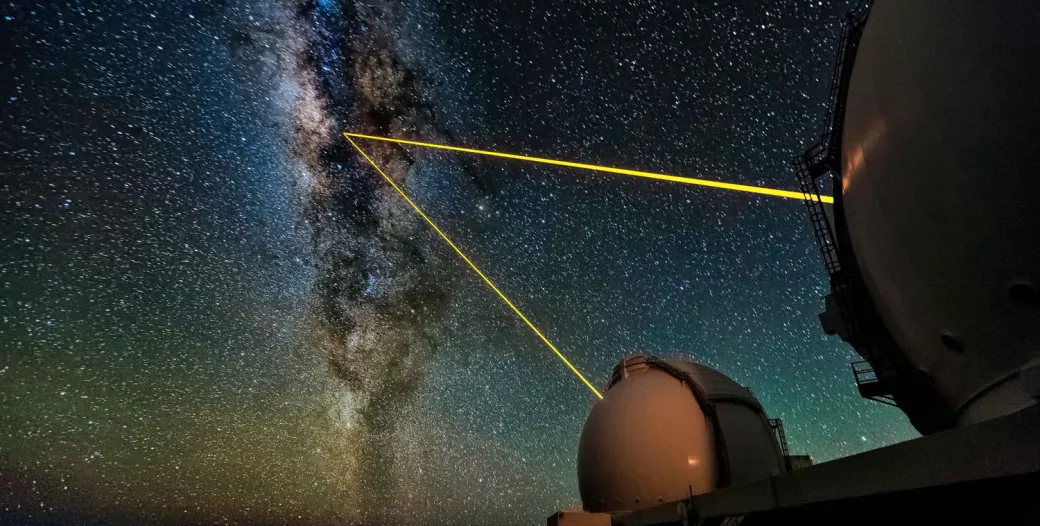
Further progress in high-angular resolution imaging techniques on large, ground-based telescopes has resulted in the more sophisticated technology of adaptive optics, which corrects for these effects in real time. This has increased the power of imaging by an order of magnitude and permitted spectroscopic study at high resolution on these telescopes for the first time. With adaptive optics, high-resolution studies of the Galactic center have shown that what happens near a supermassive back hole is quite different than what theoretical models have predicted, which changes many of our notions on how galaxies form and evolve over time. By continuing to push on the cutting-edge of high-resolution technology, we have been able to capture the orbital motions of stars with sufficient precision to test Einstein’s General Theory of Relativity in a regime that has never been probed before.
Andrea M. Ghez, professor of Physics & Astronomy at UCLA and the Lauren B. Leichtman & Arthur E. Levine chair in Astrophysics, is one of the world’s leading experts in observational astrophysics and is director of UCLA’s Galactic Center Group.
In 2020, she became the fourth woman to be awarded the Nobel Prize in Physics for her independent discovery of a supermassive compact object, now generally recognized to be a black hole in the Milky Way’s galactic center. Her work on the orbits of stars at the center of the Milky Way has opened a new approach to studying black holes, and her group is currently focused on using this approach to understand the physics of gravity near a black hole and the role that black holes play in the formation and evolution of galaxies.
Advances in high-resolution imaging technology enabled Professor Ghez’s work and her group continues to work on pushing the frontiers of these technologies forward. She serves on several leadership committees for the W.M. Keck Observatory in Hawaii, which hosts the largest telescopes in the world, and the future Thirty Meter Telescope.
Professor Ghez is also very committed to the communication of science to the general public and inspiring young girls to enter the field of science.
She earned her B.S. from MIT in 1987 and her PhD from Caltech in 1992 and has been on the faculty at UCLA since 1994. She has won numerous awards, including the Crafoord Prize in Astronomy from the Royal Swedish Academy of Science, where she is the first woman to win this prize in any field.