
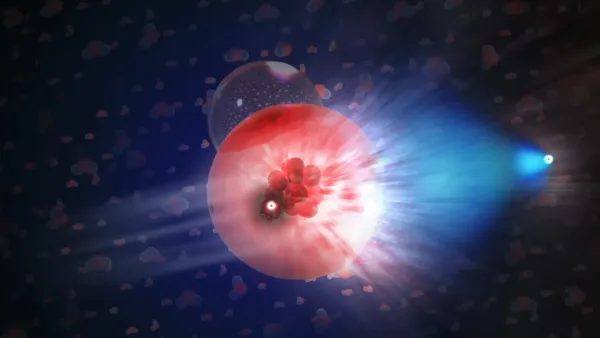
One of the strangest particle detections ever recorded: a 200 PeV event detected deep beneath the Mediterranean Sea, nicknamed the “impossible neutrino,” the signal is far more energetic than anything previously observed and raises a troubling question: why didn’t the much larger IceCube detector see it?
Bhupal Dev, associate professor of physics at Washington University in St. Louis and a fellow of the McDonnell Center for the Space Sciences, was recently interviewed by John Michael Godier for the Event Horizon podcast. They explored the perplexing 200 PeV particle detection beneath the Mediterranean Sea, nicknamed the “impossible neutrino.” This signal is vastly more energetic than previous observations and raises questions about why the larger IceCube detector did not observe it.
Their discussion delved into possibilities such as ultra-high-energy neutrinos, new physics, and rare interactions with dark matter. For a deeper exploration, watch the podcast at Event Horizon and read Dev's related article, “Dark Matter Effect as a Novel Solution to the KM3-230213A Puzzle.”


